
 Dashboard
 Order now


Finding sources is one of the most important parts of writing a research paper. Good sources give your paper evidence, credibility, and academic value. Weak sources can make even a well-written paper look unreliable.
In a research paper, sources often include:
Journal articles
Books
Government reports
Statistics
Academic websites
Interviews, surveys, or historical documents.
Many students think source-finding means typing a topic into Google and clicking the first few links. Academic research works differently. You need to know where to search, what to trust, and how to organize what you find.
In this guide, you will learn how to find sources for a research paper step by step and evaluate them for credibility.
Table of contents
Where to Find Credible Sources for Research?
You can gather reliable research paper sources from three primary locations:
Academic databases
Library collections
Authoritative websites.
Knowing which locale to browse saves you hours of aimless searching.
Academic Research Databases
An academic research database is a specific digital library that hosts thousands of scholarly journals, books, and conference papers.
Popular interdisciplinary databases, like JSTOR, cover a wide range of academic subjects and are an excellent starting point. However, you will also want to use specialized databases to find deeply technical papers.
Interdisciplinary | Science & Medicine | Social Sciences |
|---|---|---|
University Library Resources
Your university library catalog is a goldmine for finding physical books and comprehensive literature reviews. While digital articles are great for very specific recent data, published books provide deep historical context and foundational theories.
If your library does not own a specific text, do not panic. Most universities offer Inter-Library Loan (ILL) systems. This service allows your library to borrow the exact book or journal you need from another institution, entirely for free.
Reputable Online and Institutional Sources
Not all online information is purely academic, but some is still highly reputable. Institutional sources for research include raw data and publications from verified organizations, such as the World Health Organization (WHO), the United Nations, or official government portals.
These sources are excellent for pulling primary statistics, legislative reports, and current demographic data. Always verify the organization's mission statement and funding sources to ensure they do not have a hidden commercial bias.
How to Find Sources for a Research Paper in 6 Steps?
Finding high-quality references for a research paper does not happen accidentally; it requires a systematic approach. Follow the guidelines below to gather, evaluate, and track your materials effectively.
Step 1: Define Your Topic and Identify Core Keywords
To find academic sources for research, you must transform your research topic into searchable terms. Search engines cannot understand complex, conversational questions; they look for exact word matches in a text.
First, write down your topic or research question. Next, extract the core nouns and verbs. These single words will be your primary keywords.
But do not stop there. Brainstorm a list of related synonyms, alternate spellings, and broader terms for each core keyword. Different authors make different word choices, and you want to catch all of them.
Below we will provide an example to illustrate the keyword extraction process.
Example: Core Keywords in Climate Change Policy
Research Question: How does climate change affect urban infrastructure?
Core Keywords: climate change, urban, infrastructure.
Synonyms: global warming, extreme weather, cities, metropolitan, structural integrity, public works.
Step 2: Determine the Best Sources to Use for Research
Next, you must match the type of research paper source you seek with the specific needs of your study. Different stages of writing require different levels of depth.
Generally, the sources fall into three major categories – primary, secondary, and tertiary materials.
Primary sources are firsthand accounts or original data (e.g., historical letters, raw experiment results).
Secondary sources analyze or interpret primary texts (e.g., an academic essay critiquing those historical letters).
Tertiary sources offer widespread information (e.g., encyclopedias and textbooks).
Note
Always check your assignment rubric carefully before gathering materials. Professors often stipulate strict requirements, such as using at least five peer-reviewed scholarly articles while recommending not to include tertiary sources like Wikipedia.
Step 3: Choose the Best Way to Find Sources for a Research Paper
After choosing the type of sources for a research paper, the next step is to search for them efficiently. The goal is to use tools that are most likely to give you relevant academic results.
Two methods are especially useful here. You can search either in subject-specific databases or use citation chaining.
Finding Academic Sources in Subject-Specific Databases
Subject-specific databases help you find sources that are directly connected to your field.
For example, a search for "depression" in a psychology database will return clinical and behavioral studies. The same keyword in an economics database may bring up research on financial stress or recession. In other words, the database shapes the kind of results you get.
To improve your search, use the filters available in the database. You can narrow results by:
Subject area
Publication type
Date
Peer-reviewed status.
This helps you remove unrelated articles and focus on studies that match your topic.
Finding References for a Research Paper Using Citation Chaining
Citation chaining is a simple way to discover multiple good sources for research using one excellent study.
Once you find a paper perfectly aligned with your topic, scroll down to its bibliography and look at its reference list. It will help you find earlier studies that the author used.
After that, look for newer studies that cited the same article. In Google Scholar, you can do this by clicking “Cited by.” This shows you more recent papers connected to the same topic.
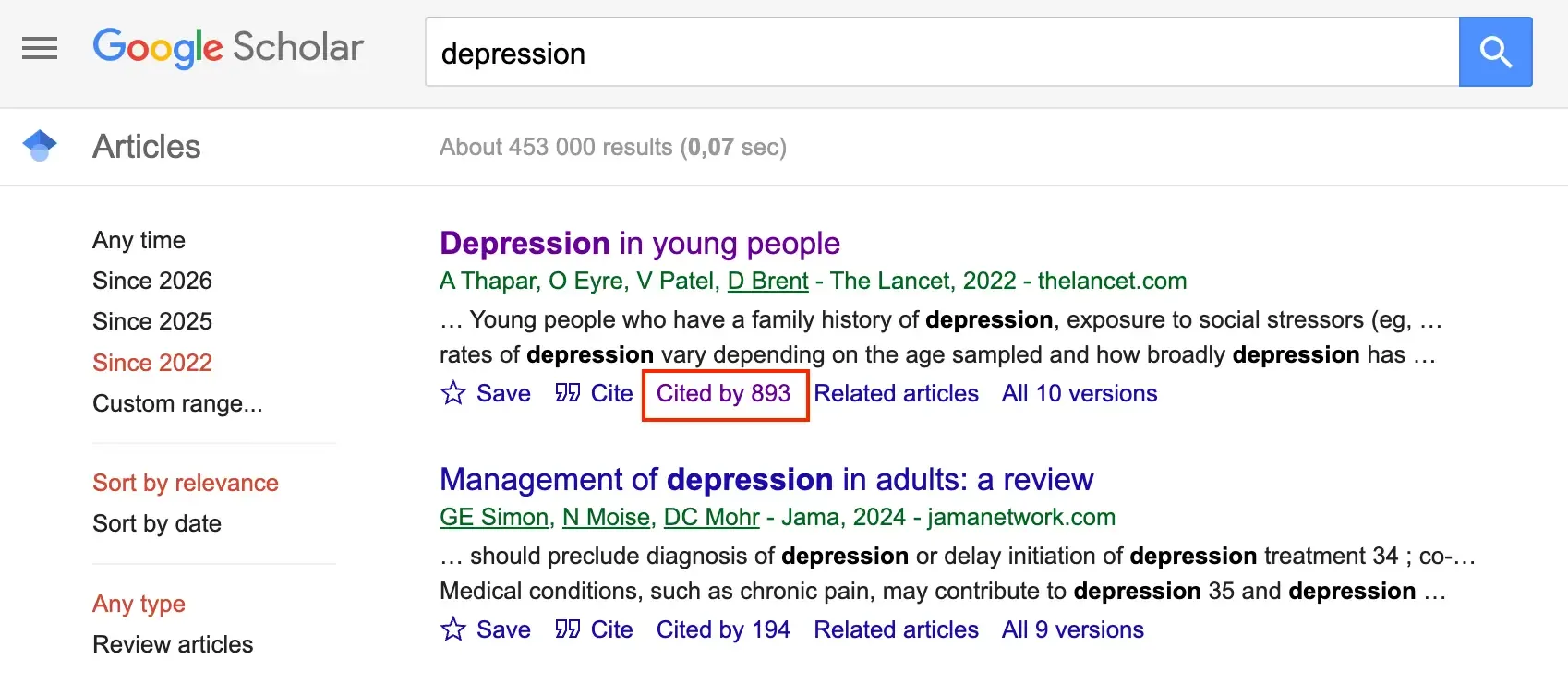
This method helps you move both backward and forward, which makes it easier to build a stronger source list.
Step 4: Apply Boolean Operators
To get better search results, you need to use search terms in a more precise way. Academic databases usually work better with keywords, not full questions or long sentences.
One useful tool is Boolean operators. These are simple words that help you combine or exclude search terms:
AND narrows the search and finds results that include both terms
OR broadens the search and includes either term
NOT removes results with a word you do not want.
These operators help you control your search and make the results more relevant.
For example:
remote work AND burnout → finds sources that include both ideas
teenagers OR adolescents → finds resources that use either word
jaguar NOT car → removes results about cars and keeps results about the animal.
Here is a full example of a Boolean search string.
Example: Boolean Search String
("climate change" OR "global warming") AND ("urban" OR "city") NOT "rural"
Step 5: Evaluate Sources for Research to Ensure Credibility
Finding a source is only half the battle. You must carefully assess the quality and intent of your findings. A source may look professional online, but that does not always mean it is reliable.
Before using any article, report, or website, check three basic things:
Authority. Who wrote it? Does the author work in this field or belong to a university, research institute, or other credible organization?
Currency. When was it published? In fast-changing fields like medicine, technology, or AI, newer sources are usually better.
Purpose. Why was it written? Some sources are meant to inform, while others are trying to sell something or promote a viewpoint.
These checks help you avoid weak, outdated, or biased material.
Analyzing Domain Extensions and Website Authority
If you find information through a regular search engine, look carefully at the website itself. One quick clue is the domain ending.
Some domain types are usually more reliable for academic work:
.edu — used by educational institutions
.gov — used by government organizations.
Such websites often provide strong data, reports, or background information.
Sites ending in .com or .org are not automatically bad, but they need more careful checking. In those cases, look closely at who runs the site, who wrote the content, and whether the information is supported by evidence.
Checking for Peer-Reviewed Status and DOIs
Another strong sign of quality is peer review. This means that an academic article was checked by experts in the same field before it was published. Peer-reviewed sources are usually more reliable than general web pages or opinion pieces.
A DOI (Digital Object Identifier) is a permanent code attached to many academic articles. It helps you find the exact source, even if the webpage changes later. In other words, a DOI works like a stable link for scholarly material.
If you want to check whether a journal is peer-reviewed, go to the journal’s official website and look for sections such as About, Journal Information, or Submission Guidelines. These pages often explain how articles are reviewed before publication.
Quick Tip
If you have a DOI but cannot access the full article, try searching the DOI in your university library system or on Crossref. This can help you find the publisher’s page or another available version.
Step 6: Track and Organize Your Research Paper Sources
Now that you know how to find credible online sources for research, you also need to learn how to manage them properly. Never rely on your browser history to find your sources again; tabs close and web histories clear.
As soon as you decide a source is useful, safely record its permalink (the permanent stable URL, not the temporary search session URL) and download the citation data immediately. Export the references directly into a citation manager like Zotero or Mendeley. This step ensures you can generate your final bibliography with a single click later.
How to Read Sources Efficiently?
You do not need to read every source for research from beginning to end right away. First, you need to decide whether the paper is actually useful for your topic.
Start with the abstract. It gives a short summary of the study, including the topic, method, and main result. If the abstract matches your topic, look at the conclusion next. This helps you quickly understand what the paper found and whether it is worth reading more closely.
If the source still seems useful, skim the main body. Read the section headings and the first sentence of each paragraph. This gives you a quick sense of the structure and main ideas without taking too much time.
Note
Skimming is helpful at the beginning, but once you decide to use a source, do not skip the methodology section. You need to understand how the study was done before you rely on its findings.
Final Thoughts on How to Find Credible Sources for Research
Efficient research starts with strong sources. When you know how to search well, evaluate what you find, and keep your materials organized, the rest of the writing process becomes much easier.
Final Tip
Begin your source research early. Academic research often takes more time than students expect, especially when you need to compare studies, check credibility, or access full texts through library systems.
Do not worry if the process feels slow at first. Finding good sources is a skill, and it becomes easier each time you do it.