
 Dashboard
 Order now


An appendix is an extra section at the end of a research paper. It includes supporting information that is useful, but too detailed to put in the main text.
You use an appendix to keep your paper easy to read. It should contain extra material, not new arguments. If something is important for your main point, it must be in the body of your study, not hidden in the appendix.
You should add an appendix in a research paper when you have:
Large or detailed data that would distract from your main writing.
Extra documents like survey questions or interview questions.
Raw data or full results that support what you summarized in the results section.
Note
Create an appendix only if it helps the reader understand the research process.
In this guide, you will learn what to include in a research paper appendix, how to format it, and how to refer to it in your paper.
Table of contents
Where Do You Put an Appendix in a Research Paper?
You usually place the appendix at the very end of your research paper. In most cases, it comes after the reference list or bibliography.
For long projects like a thesis or dissertation, some universities allow appendices to be submitted as a separate file. This can make it easier to review large tables, raw data, or extra documents.
If your paper has a table of contents, you will need to mention your appendix there so readers can find it.
Note
Always check your instructor's rules or the journal guidelines, because formatting and placement can sometimes differ.
What Goes in the Appendix of a Research Paper?
Incorporate only material that supports your study. Everything in the appendix should help the reader understand your research process or check your evidence.
Here are common items you can include in an appendix of a research paper:
Research instruments: blank copies of your survey, questionnaire, or interview questions.
Full data outputs: long tables or software results (for example, SPSS or R output) that are too large for the main text.
Extra visuals: additional charts, maps, photos, or figures that give more detail but are not essential to the main argument.
Transcripts: full interview or focus group transcripts (if required and allowed).
At the same time, keep your appendix clean. Do not include:
Unrelated items that do not connect to your research question.
Full articles written by other authors.
Repeated content that is already shown clearly in the main paper.
Extra filler added only to increase page count.
Note
Do not move key information into the research paper appendices. If a reader needs a table or figure to understand your main conclusion, it must stay in the main body.
To make this clearer, here is a simple example of what belongs in an appendix and what does not.
Example: Suitable Vs. Unsuitable Items
✔ A blank copy of the 20-question survey you gave to remote workers. This helps readers see exactly what you asked.
❌ A 50-page published report by another author about global remote work trends. That is a source you would cite in your paper, not place in your appendix.
How To Write an Appendix in a Research Paper: Step-by-Step Guide
The appendix section may seem small, but it still needs to be organized. The steps below will show you how to make an appendix for a research paper in a professional way.
Step 1: Choose the Material to Include
Start by looking at each item you want to attach. Ask yourself one simple question: Does the reader need this item to understand my main point?
If yes, keep it in the main text.
If no, but it still helps the reader check your method or evidence, put it in the appendix.
A common type of appendix material is a research protocol. This means the tools or instructions you used to collect data. For example:
Blank questionnaires or surveys
Interview questions
Raw data sets (if required)
Detailed equipment or settings (if they matter for your method).
Step 2: Group Items by Type and Purpose
Next, organize your selected materials into logical categories. Group items by type and purpose.
Do not mix different formats in one appendix. For example, keep raw statistics separate from interview transcripts. If you only have one type of material, you can use a single appendix. If you have different types, create Appendix A, Appendix B, Appendix C, and so on.
Material type | Why the reader needs it | Appendix grouping |
Blank survey forms | To show how questions were phrased | Appendix A: Survey Instruments |
Interview transcripts | To read full, unedited participant responses | Appendix B: Interview Transcripts |
SPSS data outputs | To check the calculations behind results | Appendix C: Statistical Analyses |
Keep your appendix titles clear and consistent. For instance, use the same style for all titles, and don't switch between singular and plural.
Step 3: Format Your Research Paper Appendix Properly
Your appendix should be easy to follow. Clear formatting helps readers find the right table, document, or transcript. Use the basic rules below before you label and format appendices in a research paper.
Appendix Labeling and Titles
If you have only one appendix in a research paper, label it Appendix. If you have more than one, label them with letters: Appendix A, Appendix B, Appendix C. Then, choose a short, clear title that tells the reader what is inside. Good titles use simple wording like Survey Questions or Interview Transcripts, not vague phrases like Extra Information.
Put the appendix label and title at the top of the page, and start each appendix on a new page (unless your instructor says otherwise).
If one appendix includes multiple tables or figures, label those items too:
Tables: use the appendix letter + number (e.g., Table A1, Table A2).
Figures: use the same system (e.g., Figure B1, Figure B2).
Example: Correctly Labeled Appendix
Appendix A: Remote Worker Survey Instruments
Table 1: Demographic Questionnaire
Table 2: Daily Productivity Log
Page Layout and Heading Numbering
Every appendix should start on a new page. This clearly separates extra material from your reference list and from other appendices.
Page numbers usually continue from the last page of the reference list. Do not restart page numbers at 1 unless your instructor says so. Center your appendix label and title at the top of the page, and keep the same font and spacing as the rest of your paper.
Here are the basic formatting rules most research papers follow:
Formatting rule | Standard practice |
Starts on a new page? | Yes |
Page numbers restart? | No (usually continue) |
Naming convention? | Appendix (1) or Appendix A, B, C |
Quick Tip
Always check your style guide (APA, MLA, Chicago) or your instructor's rules, because small details can vary.
Step 4: Refer to Each Appendix in the Main Text
Your reader should not have to guess where your extra material is. Every appendix must be mentioned in the main text of your work.
You can refer to an appendix in two common ways: in parentheses or in-text style.
Place the references in the parentheses when you want to point the reader to extra material without breaking the sentence.
Example: Parentheses Reference
-
The full survey (see Appendix A) shows that most participants preferred remote work at least three days per week.
-
The complete regression results (see Appendix 3, Table C) confirm the relationship between screen time and stress levels.
You can use the in-text style if you want the appendix reference to be part of the sentence.
Example: In-Text Reference
-
Appendix A contains the full survey, which shows that most participants preferred remote work at least three days per week.
-
Table C in Appendix 3 presents the complete regression results for the main model.
Research Paper Appendices Examples
A finished appendix should be neat and easy to navigate. Below are a few examples that show what a well-formatted appendix looks like in a research paper.
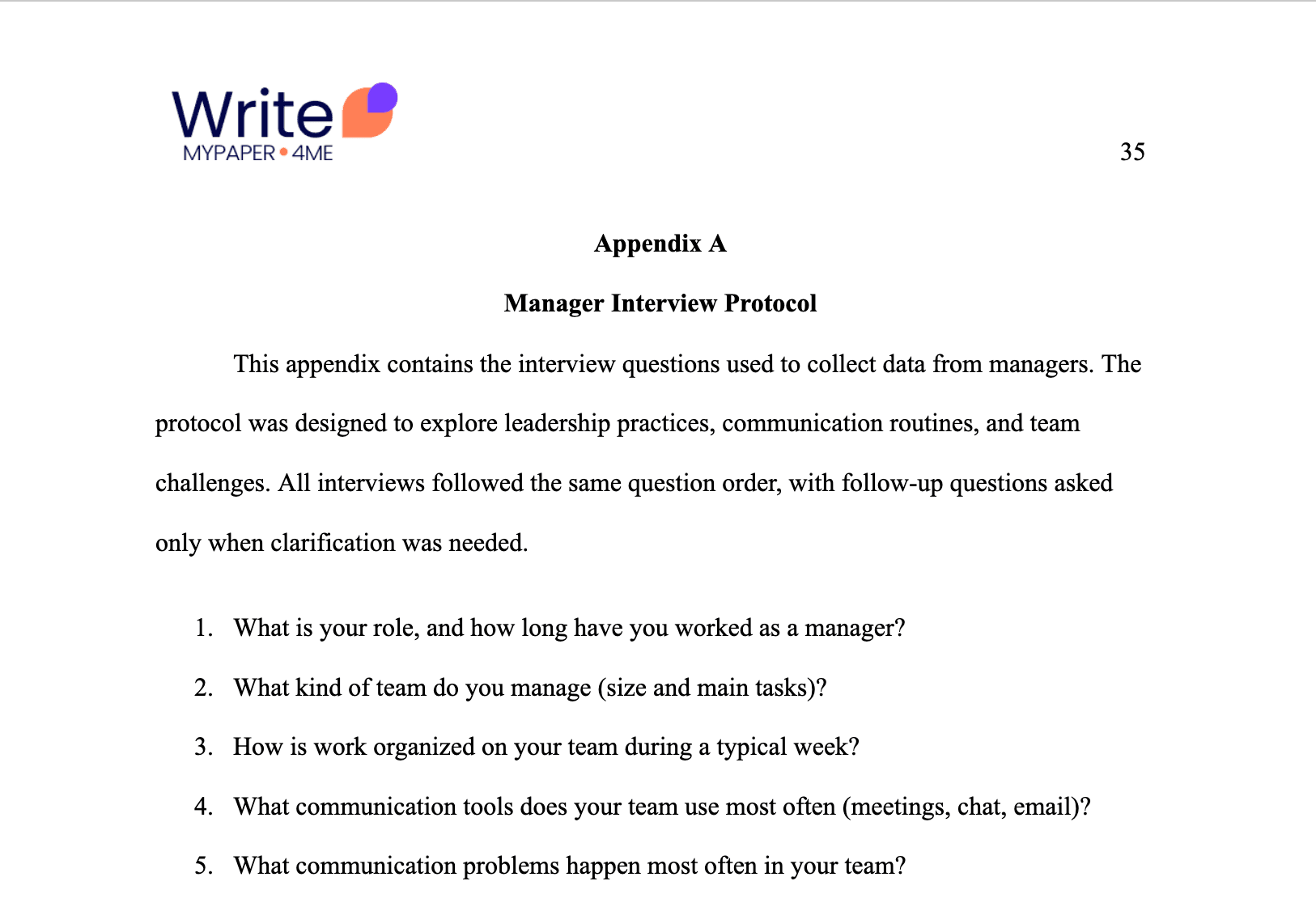
Research Paper Appendix Example: Qualitative Study
Here is a research paper appendix example that shows an interview.
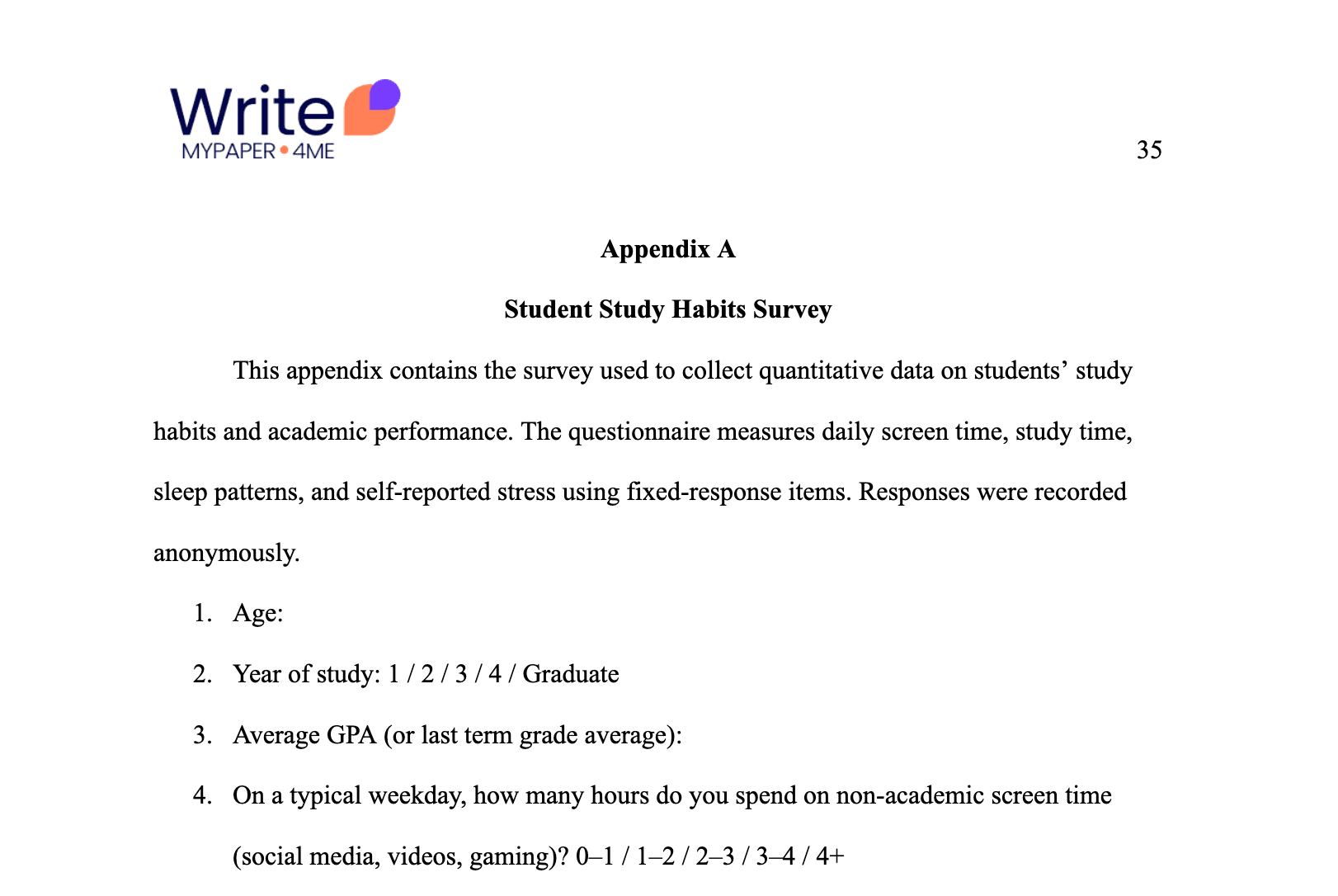
Appendices Example in Research Paper: Quantitative Data
Here is how an appendix looks when providing the exact phrasing of a numerical survey.
Common Mistakes When Creating an Appendix of a Research Paper
Here are common mistakes to watch for when creating research paper appendices:
-
Missing references.
An appendix is included, but it is never mentioned in the main text. If there is no reference, readers may not know to check it.
-
Weak labels.
An appendix is labeled (for example, Appendix A) but has no descriptive title. The reader cannot tell what it contains at a glance.
-
Irrelevant materials.
Extra notes or unrelated documents are included. This can overwhelm the reader and make the appendix look unorganized.
Final Thoughts on Appendices in a Research Paper
Keep your appendices useful, well organized, and clearly referenced. They should support your research without distracting from your main argument.
Quick Tip
Before submitting, use the search function (Ctrl+F or Cmd+F) to find every "See Appendix" reference in your paper. Check that each one points to the correct appendix, table, or figure. Incorrect references are a common formatting mistake.